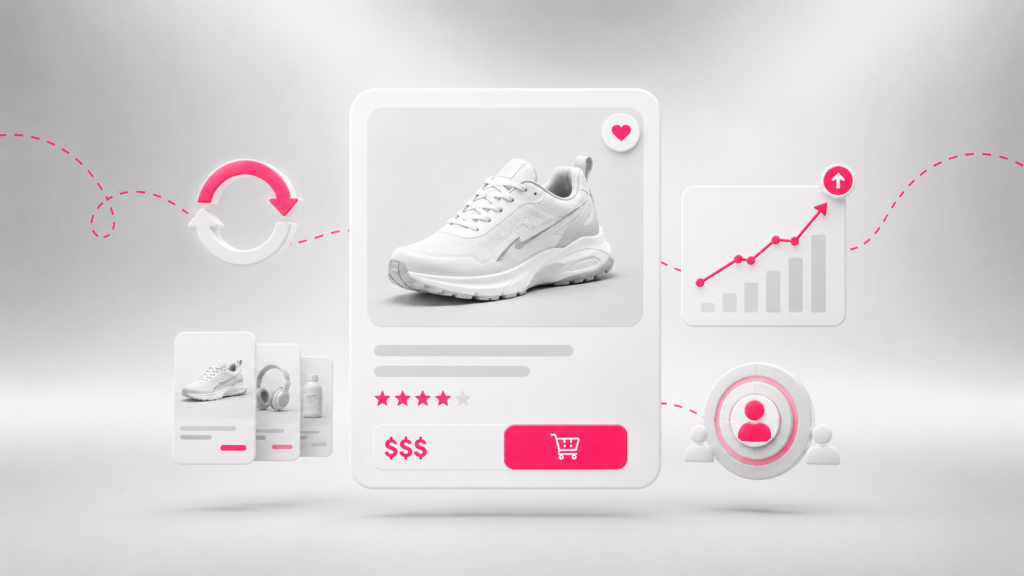

Running ads across thousands of products used to mean endless hours of manual creative work. That changed with dynamic product ads, which automatically pull items from your live catalog and serve personalized creatives to users based on their actual behavior. In 2026, mastering DPAs isn’t optional for serious e-commerce advertisers—it’s essential for staying competitive.
Key Takeaways
- Dynamic product ads automatically pull items from a live product catalog and personalize creatives based on real user behavior such as product views, cart additions, and searches.
- The most effective DPAs in 2026 combine strong catalog structure, privacy-safe tracking (pixel plus Conversions API), and machine-learning bidding to overcome signal loss from privacy changes.
- Brands typically see double-digit lifts in ROAS (20–40%) and time savings of 30–60% once DPAs are fully automated. In Q1 2025, advertisers who ran both Dynamic Product Ads and standard conversions campaigns saw 2X higher ROAS on DPA versus standard campaigns.
- This guide covers practical setup (catalog, pixel/CAPI), concrete campaign structures (retargeting then prospecting), and ongoing optimization tactics applicable across platforms.
- The article is channel-agnostic (Meta, Reddit, X, Snapchat, Amazon), with examples and dates anchored in 2024–2026 performance benchmarks.
What Are Dynamic Product Ads?
DPAs are catalog-powered ads that automatically show the most relevant products to each user across platforms like Meta, Reddit, X, and Snapchat. Unlike individual ads that require separate creative builds for each SKU, dynamic product ads scale effortlessly across your entire inventory.
These ads draw from a live product feed containing essential fields—ID, title, price, image, availability—and match items to people using intent signals such as product views, cart events, and search terms. DPAs improve time management by automating the creation of ad sets for numerous products, eliminating the need to build separate creatives for each item.
The difference between DPAs and static product ads is substantial. Static ads require manual uploads per product, limiting efficient scale to perhaps 10–50 SKUs. Dynamic ads handle thousands automatically and update whenever prices or availability change. When inventory shifts during a flash sale, your ads reflect those changes without intervention.
Here’s a concrete example: a user browsing running shoes on your site on 23 January 2026 later sees a Meta carousel ad featuring those exact shoes plus complementary socks from the same category, with a dynamic overlay showing a 20% discount pulled directly from your feed.
DPAs support multiple objectives beyond direct purchases: app installs with deep links, lead generation for high-ticket items, and even store visits for online-to-offline use cases.
Why Dynamic Product Ads Matter in 2026
Rising CPCs and signal loss from privacy changes since 2021 have made relevance and automation critical. DPAs work seamlessly across devices and multiple platforms, ensuring comprehensive user outreach even as tracking becomes more fragmented.
Quantified benefits based on 2024–2026 performance data:
| Metric | Typical Improvement |
|---|---|
| CPA | 20–35% lower |
| ROAS | 15–40% higher |
| Creative production time | 30–60% reduction |
| Catalog coverage | 90%+ active SKUs |
Dynamic Product Ads are designed to drive purchases by dynamically promoting products in the context where consumers are making buying decisions, leading to improved ad performance across the purchase journey.
DPAs help retailers, travel brands, marketplaces, and subscription businesses keep ads aligned with live inventory and pricing through hourly or daily feed refreshes. When a viewer browses flight offers on your travel site, they can later see those exact routes in their feed—no manual campaign building required.
Algorithmic delivery becomes more effective when paired with broad, high-intent audiences and rich product data. DPAs provide this by design, enabling platforms to match the right products to relevant audiences at scale. They complement brand campaigns like video ads, static creative, and creator content within full-funnel strategies.
Core Building Blocks: Catalog, Tracking, and Events
Successful DPAs rest on three technical pillars: a clean product catalog, robust tracking, and standardized events across web and app. Getting these fundamentals right determines whether your campaigns deliver client success or struggle with poor matching.
Your catalog should contain:
- Product IDs (SKU or GTIN)
- Titles and descriptions
- Product URLs and image links
- Prices and sale prices
- Availability status
- Brand and category
- Additional attributes (size, color, material)
For image quality, use at least 600×600 pixels—ideally 1080×1080 or 4:5 vertical for mobile feeds. Maintain consistent aspect ratios across your imagery to ensure professional presentation in carousel format and single-image placements.
DPAs utilize real-time data integration through features like tracking pixels to ensure ad relevance. Tracking tools such as Meta Pixel and Conversions API, Reddit Pixel, X Pixel, and Snapchat Pixel send product-level events like ViewContent, AddToCart, InitiateCheckout, and Purchase. Web events and in-app events must use the same product IDs as your catalog for accurate product matching and cross-device attribution.
Setting Up Tracking for Dynamic Product Ads
Advertisers should implement both a client-side pixel and a server-side Conversions API for more resilient measurement and optimization. This dual approach became essential after iOS privacy updates reduced pixel-only signal by 30–50%.
Pixel deployment process:
- Generate your pixel snippet via the ad platform
- Deploy across all pages via tag manager or direct code
- Ensure the base pixel fires on every page view
- Configure event-specific triggers
At minimum, configure four events for DPAs:
| Event | Parameters Required |
|---|---|
| ViewContent | content_ids, value, currency, content_type |
| AddToCart | content_ids, value, currency, content_type |
| InitiateCheckout | content_ids, value, currency |
| Purchase | content_ids, value, currency, transaction_id |
Test using official tools—pixel helper browser extensions and platform event diagnostics—and verify that event counts align with your analytics within a reasonable variance (under 10%).
For server-side events via Conversions API, use your backend or tag manager server container. Deduplicate against pixel events using consistent timestamps and event IDs to achieve 15–30% higher attribution accuracy in cookieless environments.
Building and Maintaining a High-Quality Product Catalog
Catalog quality is the biggest lever for DPA relevance and scale, especially for retailers with 1,000–100,000+ SKUs. Dynamic ads require a well-structured product catalog to effectively promote products across platforms.
You upload a feed of product details to platforms to enable DPAs. Common formats accepted in 2026 include CSV, TSV, XML, and JSON with UTF-8 encoding. Schedule fetches daily or multiple times per day during high-velocity periods.
Product data best practices:
- Descriptive titles: Brand + Type + Key Attribute + Size (e.g., “Nike Air Max 270 Men’s Running Shoe Size 10”)
- Clear pricing with accurate sale fields
- Availability flags updated in real-time
- Rich metadata including detailed descriptions and attributes
Using a product catalog rich in metadata helps improve the matching of products to relevant audiences. To maximize the effectiveness of dynamic ads, advertisers should organize their product catalog into product sets, allowing for better control over bids and recommendations.
Create logical groupings such as “All Products,” “Best Sellers Q1 2026,” “Winter Running Gear,” or “Overstock Clearance” to enable tailored campaigns and messaging.
Catalog health checklist:
- [ ] No broken image URLs
- [ ] No 404 landing pages
- [ ] No duplicate IDs
- [ ] Less than 5% disapproved items
- [ ] 90%+ active SKUs with complete data
To maximize effectiveness, use large product sets containing at least 1,000 products, as campaign performance tends to improve with a higher number of products in the set.
Creative Best Practices for Dynamic Product Ads
While DPAs pull product assets automatically, overlay design, format choice, and copy still significantly influence performance. Using high-quality imagery in dynamic ads is crucial, with a recommended minimum resolution of 600 x 600 pixels to ensure visual appeal.
Image recommendations:
- High-resolution square or vertical product images
- Clean backgrounds without clutter
- Product clearly visible without tiny logos
- Avoid hard-to-read text overlays
Add dynamic overlays for price, discount percentage, free shipping badges, or “New” tags—but keep layouts simple enough for mobile screens. Dynamic ads can adapt their messaging based on consumer behavior and preferences, allowing for personalized content that increases brand loyalty and trust.
For carousels, consider fixed cards (branded intro or offer card first, followed by product cards). Test short video ads or motion for top-performing categories where visuals need to showcase different products in action.
Dynamic ads can even utilize weather data to customize creative messages, delivering personalized promotions based on current weather conditions—showing rain jackets during storms or sunglasses during heat waves.
Mobile-first considerations:
- Fast-loading landing pages (under 3 seconds)
- Deep links into apps where available
- Clear CTAs: “Shop now,” “View deal,” “Complete your order”
Start with Retargeting: High-Intent Dynamic Product Ads
The fastest wins with DPAs usually come from retargeting shoppers who have already shown strong purchase intent. Users exposed to retargeted ads are up to 70% more likely to convert than new visitors.
Structure your retargeting with separate ad sets:
| Audience Segment | Retention Window | Messaging Approach |
|---|---|---|
| Cart abandoners | 1–7 days | Assertive CTAs, discounts |
| Product viewers | 1–14 days | Reminders, social proof |
| Broader engagers | 15–90 days | Cross-sell, new arrivals |
Excluding recent purchasers from retargeting campaigns allows advertisers to focus on acquiring new customers. Exclude buyers from the last 7–30 days depending on your repeat-purchase cycle to avoid wasted impressions and frequency fatigue.
DPAs facilitate upselling and cross-selling, encouraging repeat purchases by reminding customers of items they viewed earlier. Dynamic ads for retargeting can remind shoppers of products they viewed but didn’t purchase, and can also cross-sell complementary products from your inventory.
DPAs can set rules to automatically show complementary products to recent buyers—accessories, bundles, or higher-margin alternatives to users who purchased a base product.
Use more assertive CTAs and stronger offers (free shipping threshold reminders, time-limited discounts) for cart abandoners versus softer tailored content for casual browsers. Businesses often see a 34% increase in click-through rates by showing users the specific products they were looking for.
Increasing the audience retention window to 30 or 90 days can help advertisers reach more potential customers by targeting those who have interacted with their website or app in the past.
Expanding to Prospecting and Broad Audiences
Once retargeting delivers profitable and stable results, scale campaigns by targeting new shoppers through broad audiences and interest-based segments to reach new customers.
Run broad product-based dynamic ad campaigns where the platform chooses who sees which product, constrained mainly by geography, age, and language. This allows maximum algorithmic learning to find your target audience.
Prospecting campaign recommendations:
- Test separate campaigns for key product sets (“New Arrivals Spring 2026,” “Top Rated Products,” “Category Bestsellers”)
- Control budget allocation across sets based on margin and inventory
- Allow 50+ conversion events per ad set per week for stable learning
Avoid overlapping heavy filters with multiple interest, behavior, and lookalike layers. Over-filtering restricts delivery and makes it harder for the algorithm to find conversions at scale.
Customize ad copy for new-to-brand users—focus on value proposition, social proof, and ease of returns. This differs from retargeting copy that emphasizes reminders, urgency, and personalized nudges based on the viewer’s previous site behavior.
Bidding, Budgets, and Optimization Strategies
Modern DPA campaigns perform best with value-based or conversion-optimized bidding rather than clicks or impressions. Dynamic ads yield lower CPAs and higher ROI when optimizing towards conversions compared to other touchpoints, including clicks.
Optimizing dynamic ads for conversions yields lower CPAs and higher ROI compared to optimizing for other touchpoints, making it essential to focus on conversion metrics. Optimize for events closest to the business goal—usually the purchase event—using a standard attribution window (7-day click, 1-day view) unless your data suggests otherwise.
Budget strategy guidelines:
- Set budgets large enough for 50+ conversion events per ad set per week
- Avoid frequent, abrupt budget changes that reset learning
- Scale gradually with 10–20% increments based on 7–14 day performance
Once stable performance is achieved, test CPA targets or ROAS goals. Ongoing experimentation—rotating custom audiences, testing catalog segments, creative overlays, and seasonal offers—drives continuous improvement. Limit simultaneous changes to isolate which variables impact campaign performance.
Measurement, Testing, and Incrementality
Measuring the true impact of DPAs requires more than examining last-click conversions in a single platform dashboard. Cross-channel effects and view-through conversions often go unmeasured without proper attribution.
Set up clear KPI baselines—CPA, ROAS, AOV, frequency, and conversion rates—before scaling DPA budgets. This process ensures you can accurately measure improvements.
Incrementality testing approaches:
- A/B holdout tests where a randomized control group doesn’t see DPAs
- Estimate incremental lift in sales and revenue (typically 10–30%)
- Compare against organic and email-driven conversions
Track downstream metrics: repeat purchase rate, subscription renewals, and customer lifetime value for consumers first acquired via DPA campaigns. Use cross-channel attribution tools—analytics platforms, marketing mix modeling, or incrementality tests—to understand how DPAs interact with email, search, and organic traffic.
Common Pitfalls and How to Avoid Them
Many underperforming DPA setups fail due to catalog, tracking, or targeting mistakes rather than the format itself. Identifying these issues early prevents wasted budget and frustration.
Common catalog and tracking issues:
| Problem | Impact | Solution |
|---|---|---|
| Mismatched product IDs | Poor matching, low relevance | Ensure site and feed use identical IDs |
| Low-quality images | 40% CTR drop | Use 600x600px minimum |
| Broken landing pages | Lost conversions | Daily URL validation |
| Pixel-only tracking | 30–50% signal loss | Add Conversions API |
Over-segmentation creates problems too. Too many tiny ad sets and product sets with fewer than 50 weekly conversions fragment learning and reset optimization. Avoid excessive manual tweaks during high-traffic events like Black Friday or Singles’ Day 2026.
Quarterly maintenance checklist:
- [ ] Audit catalog coverage and disapprovals
- [ ] Revalidate pixel and CAPI events
- [ ] Refresh creative overlays for seasonality
- [ ] Review audience exclusions
- [ ] Align campaigns with current inventory priorities
Dynamic Product Ads for Key Vertical Use Cases
While the mechanics are similar across industries, execution details differ for retail, travel, marketplaces, and subscription services.
Retail and Fashion: Use product sets for seasons (Spring/Summer 2026), categories (sneakers, outerwear), and promotion periods (mid-season sale, last-chance outlet stock). Rotate creative overlays to match promotional messaging.
Travel and Experiences: Structure feeds around destinations, dates, and price ranges. DPAs can promote recently viewed flight offers or similar trips. Date-based feeds enable personalization around travel windows.
Marketplaces: Manage multi-merchant catalogs with brand filters and quality control. Prevent low-quality listings from dragging down overall performance through strict feed standards.
Subscription and Digital Products: Bundle plans and add-ons in the catalog. Highlight trial offers and support retargeting users who viewed pricing or started sign-up flows but didn’t complete purchases.
Planning Around Seasons and Key Retail Moments
DPAs shine during peak periods like back-to-school, Black Friday/Cyber Monday 2026, and major regional holidays when advertising volume and consumer engagement spike simultaneously.
Preparation timeline:
- 4–6 weeks before events: Prepare seasonal product sets (“Holiday Gifting 2025–2026,” “Summer Essentials 2026”)
- 2–3 weeks before: Warm up broad audience DPA campaigns to build data
- Event week: Increase budgets gradually as milestones approach
Test countdown messaging and time-limited offers in dynamic overlays while ensuring prices and availability stay accurate via frequent feed refreshes.
Post-peak strategies matter too: use DPAs to clear remaining inventory in January sales or deliver early access promotion for next-season collections to engaged website visitors.
Frequently Asked Questions
Are dynamic product ads only for large retailers with huge catalogs?
While DPAs provide the most leverage for catalogs of 100+ SKUs, even smaller brands with 20–50 products can benefit from automation and personalization. The key requirement is a structured catalog with consistent product IDs rather than sheer catalog size. Businesses with limited SKUs still gain from automated creative updates and behavior-based targeting.
How often should I refresh or update my product feed?
Daily refreshes work for most e-commerce brands under normal conditions. During high-velocity periods like promotions, flash sales, or holiday weekends, update feeds every few hours. Feeds must reflect current prices, stock status, and URLs to avoid user frustration when they click through and find outdated information—which also creates policy issues on most platforms.
Can I run dynamic product ads if I don’t have a mobile app?
A mobile app is not required. DPAs work perfectly with web-only stores, sending users to responsive product pages on your site. If an app exists, implementing deep linking and tracking in-app events can further improve conversion rates and measurement accuracy, but it’s entirely optional.
What budget do I need to start testing dynamic product ads?
Aim for enough budget to drive at least 50–100 conversion events per week per main ad set, which often translates to test budgets in the low thousands of dollars monthly. Start smaller with retargeting-only campaigns where conversion rates are higher, then scale prospecting budgets once performance stabilizes and you’ve validated your setup.
How long should I wait before judging performance of a new DPA campaign?
Allow at least 7–14 days and sufficient conversion volume before making strong decisions. Algorithms need time to exit the learning phase and optimize delivery. Avoid pausing or radically changing campaigns based on 1–2 days of data, especially during weekends or holidays when user behavior fluctuates significantly from weekday patterns.